Manufacturing
The expert in their pocket,
on every client floor.
Skilled field technicians deployed a support tool on Forra that puts the full documentation library at their fingertips, with source-traced answers in seconds on any device.
The challenge
A new product. A lot of documentation. A technician on the clock.
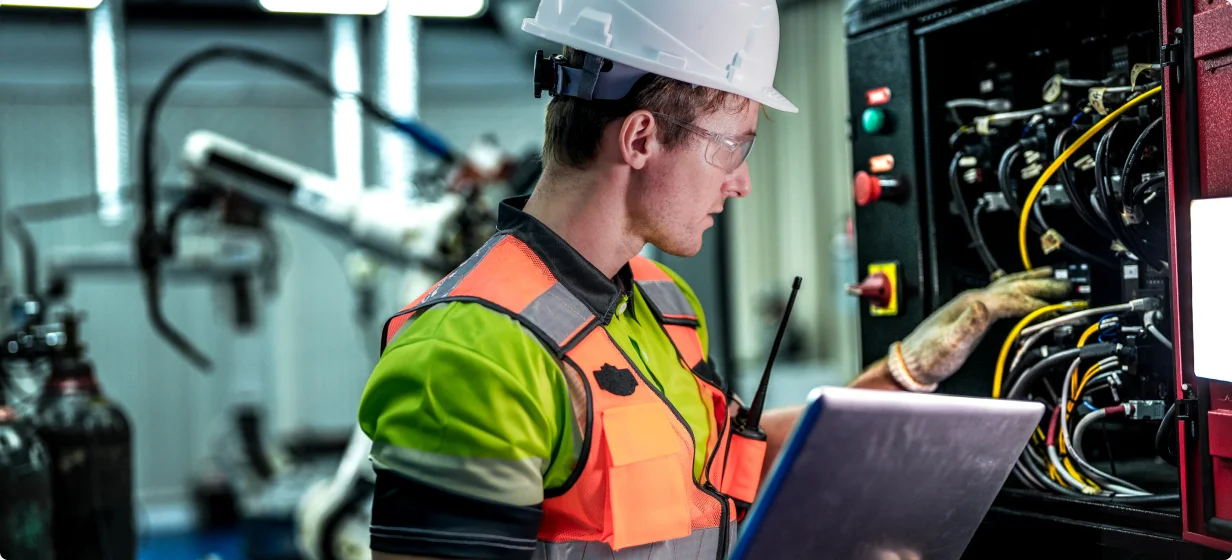
The collaborative robotics solution is a modular system. Each installation combines multiple components: a robot, a palletizer, a conveyor, and more, each with its own technical documentation, error codes, settings, and procedures. The technicians who service these systems carry deep product knowledge. When something goes wrong on a client’s production line, they know what to look for. They just need to find it fast.
The challenge is that the right answer could live in any of dozens of documents: manuals, startup procedures, shutdown sequences, error message glossaries, troubleshooting guides. On a factory floor, with a production line stopped and a client waiting, even the most experienced technician can’t search that volume quickly enough.
The goal was clear from the start: give technicians a tool that matches the speed of their expertise, so they can resolve issues autonomously without calling back to base.
The solution
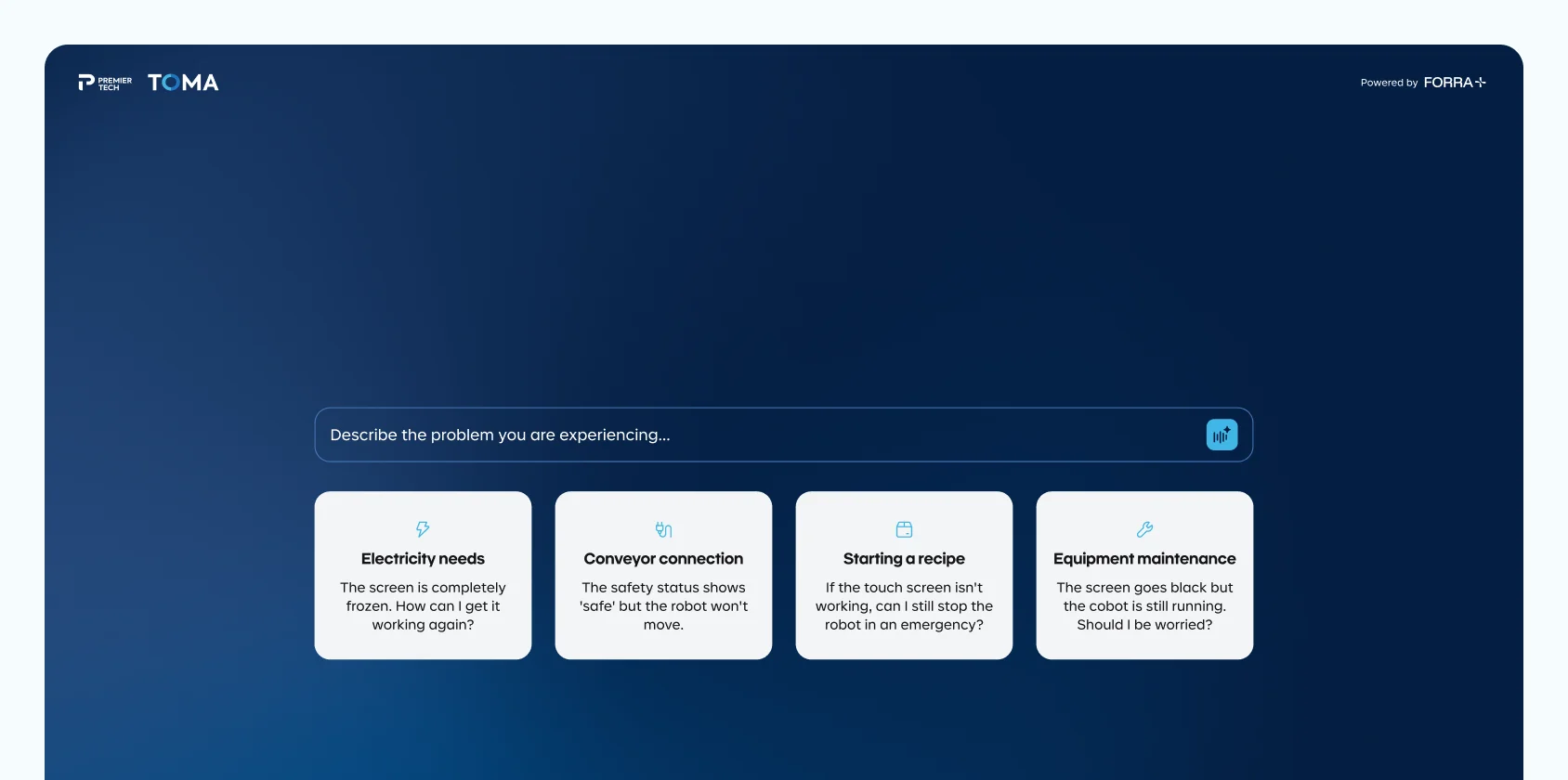
Ask the question, get the answer, and see exactly where it comes from.
Mirego built the technical support assistant directly on Forra. The result is a conversational support tool that covers every technical aspect of the robotics ecosystem: startup and shutdown procedures, error messages, settings configuration, and step-by-step troubleshooting guides.
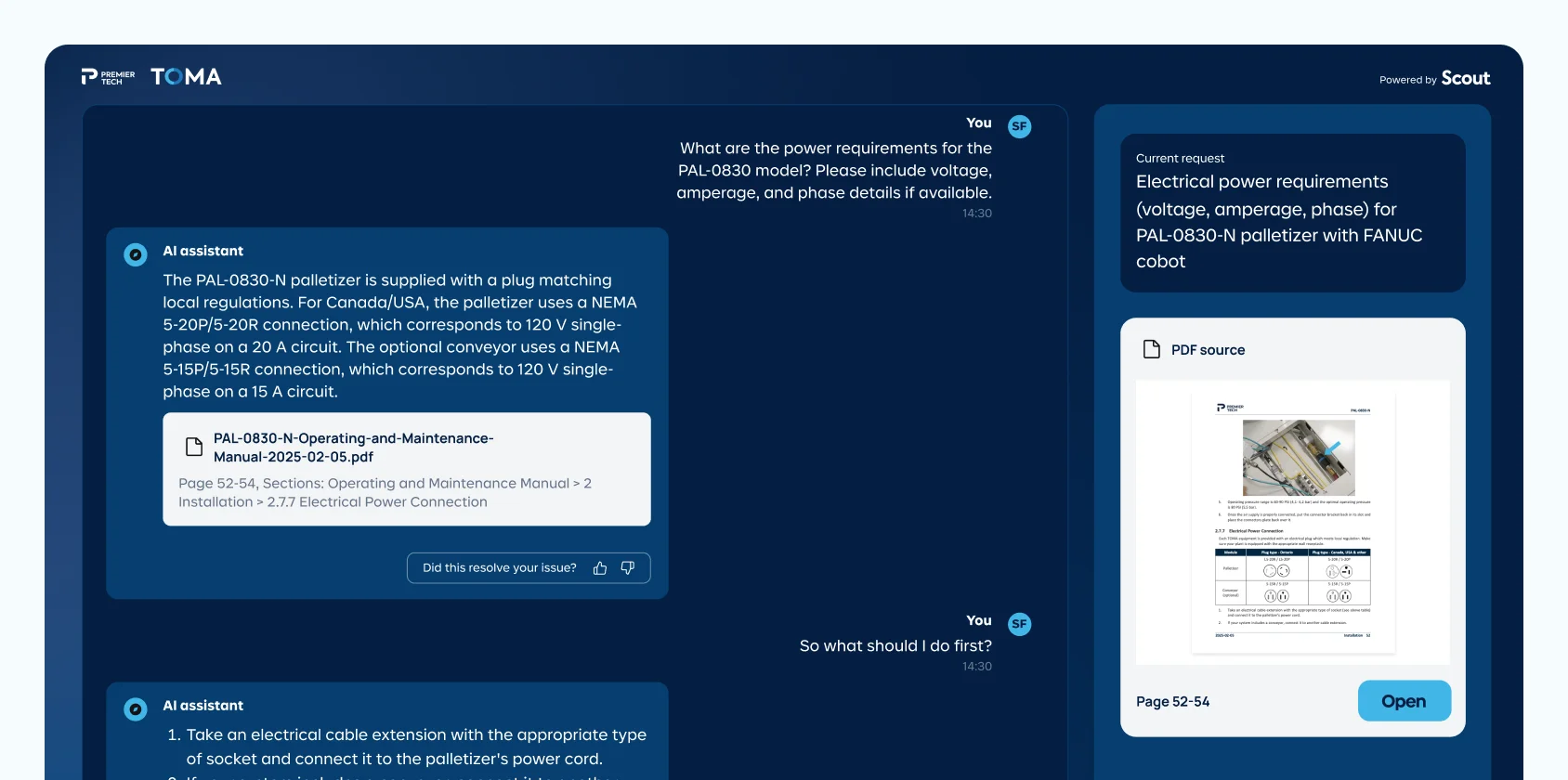
A technician on a client’s site types their question in plain language. The assistant searches across the entire documentation library simultaneously, across all components and all manuals, and returns a clear, structured answer with the exact source and location in the document so the technician can verify it themselves if needed.
That last part matters. The tool isn’t asking technicians to trust a black box. It shows its work. Every answer comes with a reference, which builds confidence in the field and keeps the human in control of the final call.
Because it’s built on Forra, the tool was deployed without building and maintaining custom infrastructure from scratch. The team focused entirely on what mattered: the quality of the answers and the reliability of the source tracing.
The outcomes
Autonomous technicians, faster restarts, fewer escalations.
- Technicians resolve issues on-site, independently, applying their expertise with the full documentation library behind them.
- Every answer includes the exact source and location in the documentation, so technicians can validate the information and act with confidence.
- The tool covers the full technical ecosystem across all components and manuals, from a single interface.
- Downtime reduced because the time between identifying an issue and finding the right procedure collapses from minutes to seconds.
- New technicians ramp up faster, building on the same knowledge base that seasoned experts rely on, from day one in the field.
- Built on Forra, the solution was production-ready without the overhead of custom infrastructure, letting the team focus on answer quality rather than platform architecture.


Eddyfi’s knowledge base already had the answers.
Finding them was the hard part.
Purpose-built AI agents replace a generic assistant, achieving 87.5% accuracy on a validated benchmark versus 12% for Microsoft Copilot.

The power of experience: capturing 30 years of knowledge.
AI transcribes expert interviews, identifies speakers, and turns institutional knowledge into a searchable resource for your entire team.

The answer already existed; reaching it just took 15 hours.
AI research agent searches four scientific libraries simultaneously and delivers a complete, sourced report in minutes instead of hours.