Food Manufacturing
A Certificate of Analysis for every lot, validated in seconds instead of hours.
A QA team with rigorous standards deployed an AI assistant on Forra to handle the mechanical validation work, getting a complete, trustworthy report in seconds while keeping the specialist in every decision.

The challenge
A rigorous process, stretched thin by volume.
The client must attach a Certificate of Analysis to every lot they ship. No COA, no delivery. The QA team had built a thorough validation process: open two large Excel workbooks, scan conformity flags across hundreds of palettes, cross-reference moisture and water activity measurements against product specs, and verify that lab results for E. coli and Salmonella were present and conforming.
Every lot, every time: the discipline was there.
But the volume made it unsustainable. The specialist’s real value lies in the judgment calls: the non-conforming palettes, the borderline results, the exceptions that require experience. The mechanical scanning consumed the time that should have gone to those decisions. And at scale, even the most diligent team faces the limits of repetitive manual work across hundreds of rows.
There was also a data reliability factor. The quality tracking file had known quirks: the production date it recorded could be inaccurate, which had previously forced a full revalidation pass after a system update. The specialist had built effective workarounds, but those workarounds were hard to transfer and invisible to anyone new to the role.
The solution
Human-in-the-loop by design.
Mirego built a QA validation assistant directly in Forra, designed around one principle: remove the mechanical burden without removing the specialist from the process. Forra handles the validation. The technician reviews the result, asks questions if something needs clarification, and signs off. The operator stays accountable. The repetitive work disappears.
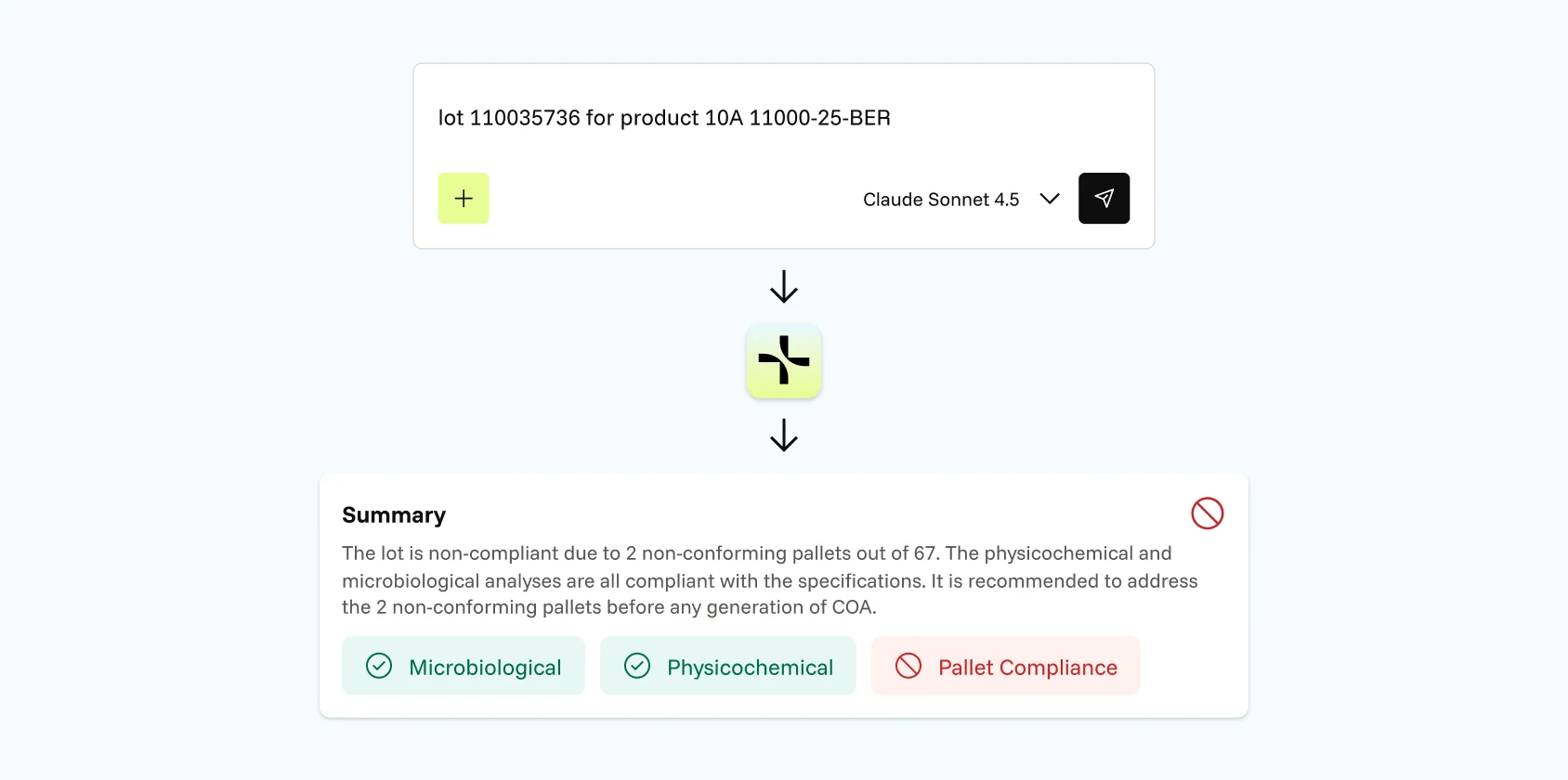
When validation runs, the assistant doesn’t just return a pass or fail. It produces a full breakdown of every check performed: which palettes were conforming, what the moisture and water activity values were, what the lab results showed for each sample. If something fails, the report names exactly what failed and points to it. If something warrants attention without blocking validation (a borderline value or a non-applicable measurement), it surfaces that too, so the technician is never caught off-guard downstream.
The assistant supports two triggering modes. It can run on a schedule, automatically scanning for lots released in the production system and ready for validation. Or a technician can trigger it ad-hoc by typing a product code and lot number directly in the chat. Both modes produce the same structured, complete report.
The outcomes
The mechanical checks disappeared; the specialist’s judgment didn’t.
- The specialist now receives a complete validation report in seconds, freeing the time that went into scanning hundreds of rows across two workbooks.
- The validation runs the same way every time, against live data, with no steps skipped, matching the consistency the team always aimed for.
- Edge cases that are hardest to catch at volume, like a single non-conforming sample buried in a multi-sample lot or a missing lab result, are surfaced consistently.
- When something fails, the report says what, where, and which palettes are affected. The specialist knows exactly what to look at without retracing the validation themselves.
- Lots released overnight are already validated by the time the team arrives in the morning, with no one having to remember to check.
- Because the report shows actual values and reasoning, the technician can trust the process, not just the result, and move forward with confidence or flag a concern knowing exactly what prompted it.


Eddyfi’s knowledge base already had the answers. Finding them was the hard part.
Purpose-built AI agents replace a generic assistant, achieving 87.5% accuracy on a validated benchmark versus 12% for Microsoft Copilot.

The power of experience: capturing 30 years of knowledge.
AI transcribes expert interviews, identifies speakers, and turns institutional knowledge into a searchable resource for your entire team.

The answer already existed; reaching it just took 15 hours.
AI research agent searches four scientific libraries simultaneously and delivers a complete, sourced report in minutes instead of hours.