Retail & Distribution
Predicting demand before the weather decides for you.
A sales team with years of weather-driven forecasting experience deployed AI on Forra, turning hard-won market intuition into a structured, proactive demand prediction system.

The challenge
Strong market instincts, limited by manual data gathering.
The sales team had developed sharp instincts for reading weather-driven demand. They tracked conditions city by city, cross-referenced patterns with historical sales, and used that experience to anticipate spikes and drops. Their read on the market was often right.
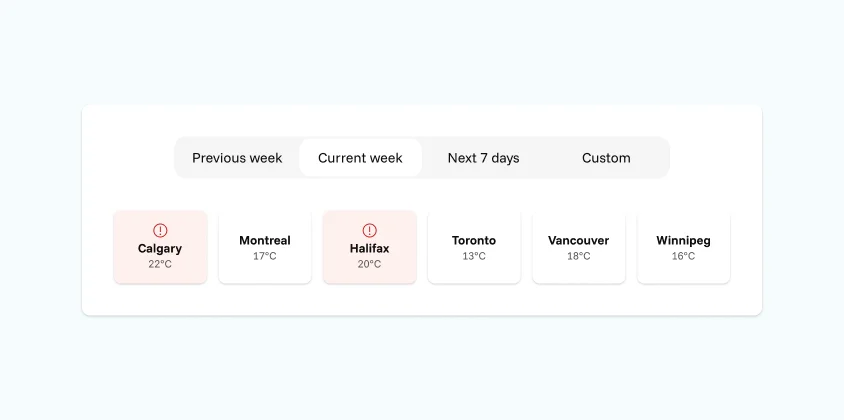
But the data gathering couldn’t scale. Weather signals were scattered across sources, disconnected from sales tools, and impossible to monitor simultaneously across 10 cities. Detecting an incoming cold snap in Montreal while managing inventory for Vancouver and Calgary required more throughput than any team could sustain manually. Outliers, whether a freak storm or an unseasonably warm October, were caught too late to act on.
The solution
A two-phase proof of concept. Built to validate before scaling.
Rather than committing to a full platform, Mirego scoped the project as a focused PoC in two phases, designed to confirm that AI was the right tool for the client’s needs before investing further.
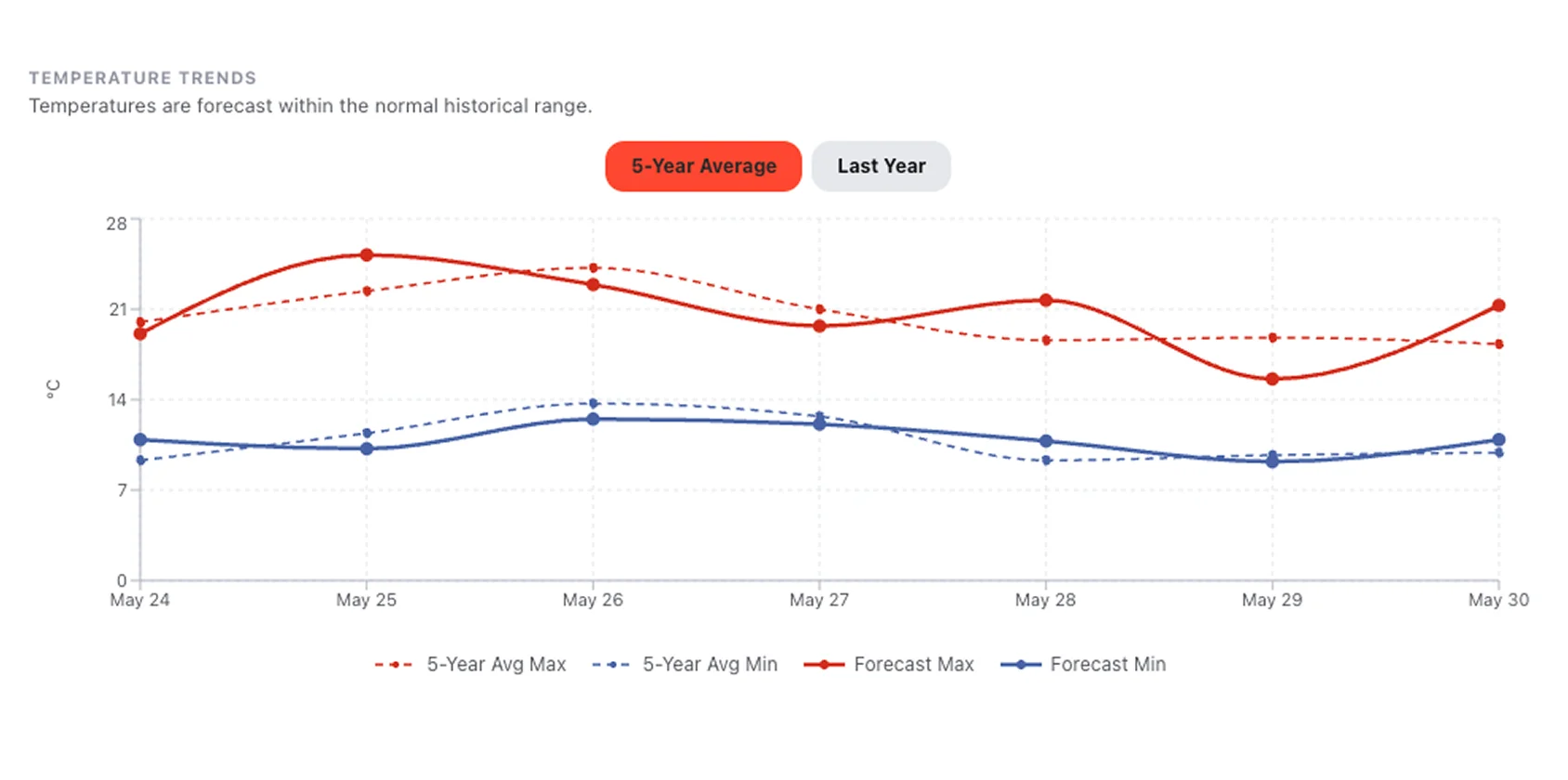
Phase 1 - Weather data gathering Mirego built an application on Forra that collects, structures, and visualizes weather data across up to 10 Canadian cities. Sales and operations teams can access historical, current, and forecast data through a clean interface, and export everything to a structured Excel document for sharing across teams. The team’s existing knowledge now sits on top of a single, always-current data layer.
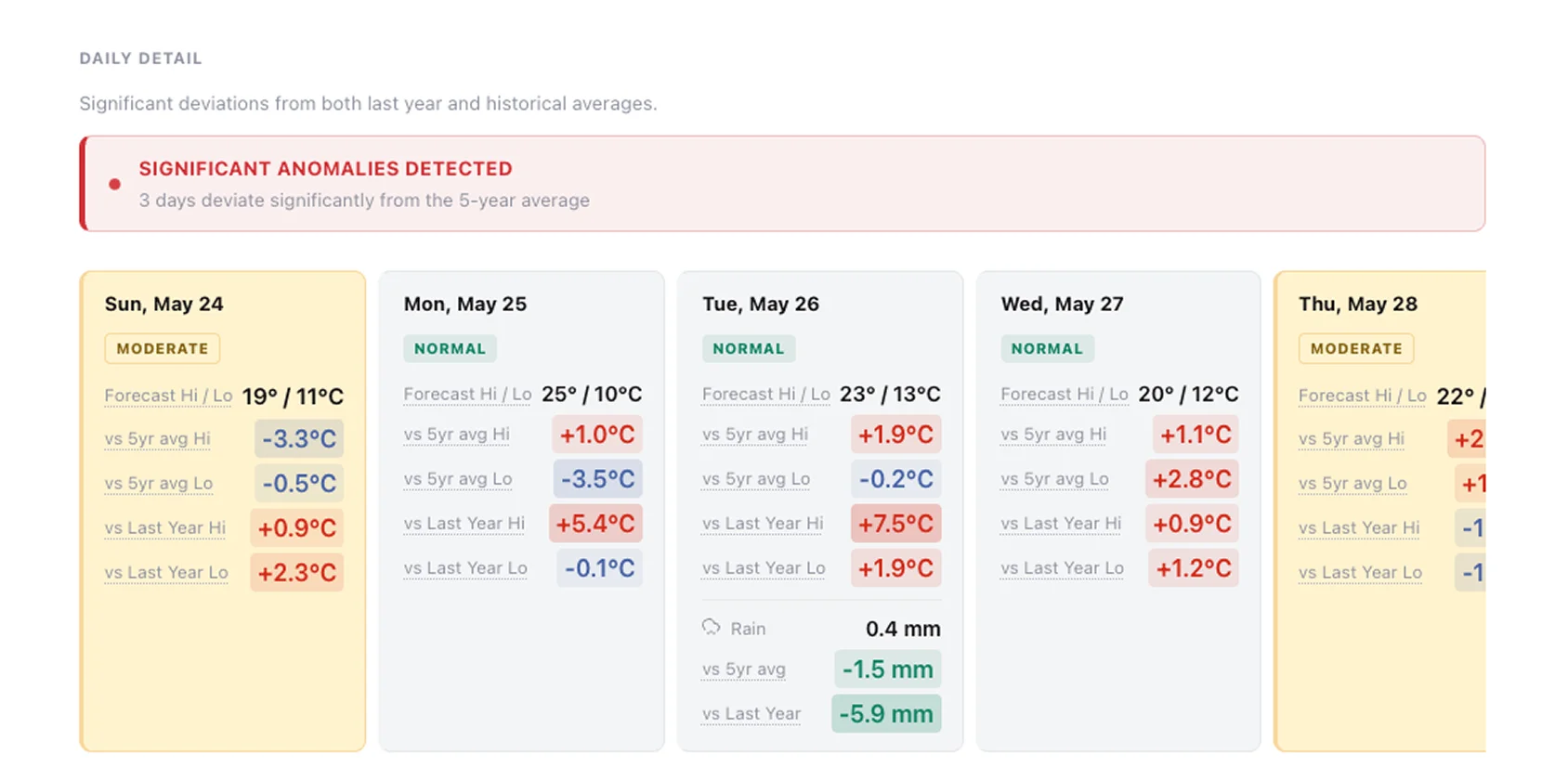
Phase 2 - Automatic outlier detection Building on the foundation of Phase 1, the application was extended to actively identify anomalies. Based on upcoming weather forecasts and past sales cycles, the system flags events likely to affect demand, whether triggered by rules defined by the sales team or surfaced automatically from historical patterns. A monitoring module keeps teams informed in real time.
The outcomes
From reactive to proactive, in two phases.
- Weather data collection automated across 10 Canadian cities, giving the team a single, always-current feed.
- Sales teams can now pair their market experience with real-time weather intelligence, anticipating demand shifts before they impact inventory or revenue.
- Outliers detected automatically, based on both historical patterns and rules the sales team defined from their own experience.
- Structured Excel exports enable seamless cross-team sharing with no extra processing.
- The phased PoC approach validated the AI use case with minimal risk, before committing to full-scale development.
- Phase 2 opens the door to a continuous monitoring loop, where every sales cycle feeds back into smarter future predictions.


Your knowledge base isn’t the problem.
How it is searched or used, is.
Purpose-built AI agents replace a generic assistant, achieving 87.5% accuracy on a validated benchmark versus 12% for Microsoft Copilot.

The power of experience: capturing 30 years of knowledge.
AI transcribes expert interviews, identifies speakers, and turns institutional knowledge into a searchable resource for your entire team.

The answer existed. Reaching it just took 15 hours.
AI research agent searches four scientific libraries simultaneously and delivers a complete, sourced report in minutes instead of hours.